
Recent headlines point to a “slowdown” in zero-emission truck deployments. At first glance, the data appears to support this view: total U.S. zero-emission truck (ZET) deployments declined year-over-year in the first half of 2025.
But that headline misses the real story.
According to CALSTART’s January 2026 Zeroing in on Zero-Emission Trucks market update, the U.S. ZET market is not retreating. It is concentrating — by vehicle segment, by geography, and most importantly, by charging infrastructure readiness.
For fleets, utilities, and fleet charging infrastructure providers, this shift matters far more than topline deployment counts.
From Broad Adoption to Targeted Scale
More than 59,000 zero-emission trucks are now deployed nationwide, spanning cargo vans, medium-duty trucks, heavy-duty trucks, refuse vehicles, and yard tractors. While overall deployments dipped in early 2025, five of the six major vehicle segments continued to show strong momentum. Medium-duty trucks and yard tractors both posted their strongest six-month deployment periods on record.
The apparent slowdown is almost entirely attributable to cargo vans, which make up roughly 88 percent of all deployed ZETs. Because that segment is already relatively mature — with lower upfront costs and simpler fleet charging requirements — short-term fluctuations there have an outsized impact on national totals.
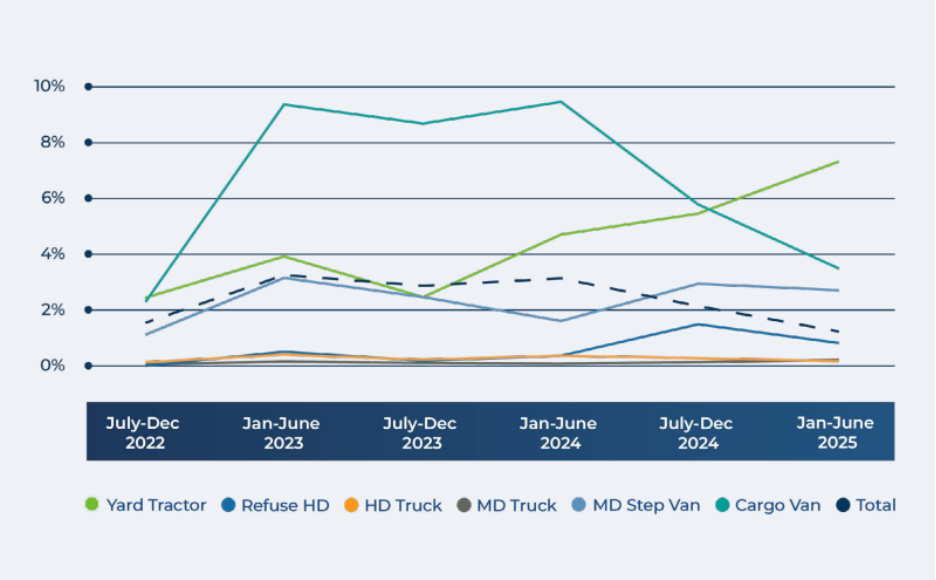
Meanwhile, the growth engine of the next phase is becoming clear: medium- and heavy-duty electric trucks operating predictable routes, supported by EV fleet charging infrastructure that is designed for scale, uptime, and operational certainty.
Regional Routes Are Emerging as the Sweet Spot
One of the most important insights in the CALSTART report is the emergence of regional freight corridors as economically compelling use cases for battery-electric trucks. Routes in the 300–400 mile round-trip range — such as Chicago–Indianapolis, Houston–San Antonio, or Cleveland–Pittsburgh — now fall squarely within the operating envelope of long-range electric trucks.
For these routes, the economics are no longer theoretical. Fuel savings alone can reach $34,000–$45,000 per truck per year, with total cost parity achievable within three years even before incentives. That math only works, however, if fleet charging solutions are reliable, well-sited, and integrated into fleet operations.
This is where the industry’s focus is shifting: away from “Can electric trucks work?” and toward “How do we build fleet charging infrastructure that fleets can trust at scale?” your charging infrastructure includes robust energy management capabilities. It’s not just about the chargers themselves—it’s about the intelligent software managing the whole system.
Infrastructure, Not Vehicles, Is the Gating Factor
The report makes clear that vehicle technology is no longer the primary constraint. Battery-electric trucks now deliver strong fuel efficiency, lower maintenance costs, and higher driver satisfaction compared to diesel. The constraint has moved downstream.
EV fleet charging infrastructure — particularly for medium- and heavy-duty fleets — must contend with permitting timelines, utility coordination, make-ready upgrades, site power constraints, and operational uptime expectations that leave little margin for error.
CALSTART highlights several models that are helping bridge this gap: utility make-ready programs, shared charging depots, charging-as-a-service models, and port-based hubs where infrastructure investment can be pooled across multiple fleets.
Ports, in particular, are emerging as first movers with port electrification initiatives. With concentrated vehicle demand and predictable duty cycles, ports allow fleet charging infrastructure to be highly utilized, improving economics while accelerating emissions reductions across entire regions.
State Leadership Is Driving Real Progress
Another critical takeaway from the report is that absolute deployment numbers can be misleading. When deployments are normalized against each state’s total truck stock, a different set of leaders emerges.
California remains the clear frontrunner, but states like Washington, Wisconsin, Georgia, and New Jersey rise to the top when progress is measured relative to market size rather than raw volume.
What these states share is not just policy ambition, but coordinated execution: incentives paired with infrastructure planning, utility engagement, and clear signals to fleets that the fleet electrification transition will be supported, not stalled by friction.
For fleet charging solutions providers, this reinforces a key lesson: growth will concentrate in markets where electric vehicle fleet charging deployment can move in parallel with vehicle adoption, not lag behind it.
What This Means for Fleets and Charging Providers
The zero-emission truck market is entering a more disciplined phase. Fleets are no longer experimenting at the margins. They are scaling where the operational case is clear, routes are predictable, and EV fleet charging solutions partners can deliver certainty.
For fleet charging providers, this raises the bar. Success is no longer about installing chargers alone. It requires system-level thinking: site design, grid integration, redundancy, serviceability, and long-term operations through managed charging services.
The CALSTART data shows that the next wave of growth will favor solutions that treat depot charging as mission-critical infrastructure — not an afterthought to vehicle procurement.
At Camber Charging, this aligns with what we see every day in the field. Fleets that invest early in well-designed, reliable commercial EV charging infrastructure are the ones positioned to scale confidently as electric fleet vehicles move from pilot to core operations.
The transition is not slowing. It is getting sharper.
And the companies that win the next phase will be the ones that build fleet charging infrastructure to match the ambition of the vehicles they support.
References
CalStart (2026, January). Zeroing in on Zero-Emission Trucks: January 2026 Market Update. https://calstart.org/zio-zets/
